“Shrapnel” is from Children of the Barcode, winner of the 2025 Laura Adelina Ward Prize for creative essay
Feb – Nov 2022
As data visualizations, they do not require any indexical reference to their object. They are not dependent on the actual impact of photons on a sensor, or on emulsion. They converge around the average, the median; hallucinated mediocrity. They represent the norm by signaling the mean. They replace likenesses with likelinesses. They may be ‘poor images’ in terms of resolution, but in style and substance they are: mean images.
—Hito Steyerl, “Mean Images”
It is a privilege to know where you come from. It is a privilege to know who you are. How easy it is to reach back into the family catalog and point without hesitation or doubt to a thrice-removed cousin. To have lists of uncles who died in Vietnam in their teens. Jars of pets and grandmas. And all the memorabilia—the plate, the uniform, the catheter bag, the expired soup cans, the stories. Toni Morrison says writing about family is an “archeological site.” I say a family is working full-time as a surgeon without even knowing it: you dig up shrapnel leaking into you. I hope someone has told you to look for it. I hope you know those who think this shrapnel doesn’t harm them. It is just as much a privilege to invent who you are.
My brother is technically my step-brother—but we don’t aim that epithet against each other. Or we do when people see a six-foot-one, peacoat-wearing fin-tech bro with blue eyes and dark brown hair and ask how we could have possibly come from the same womb or wad. We didn’t. We’re both donor babies, but not from the same man. Although, most Ashkenazim are seventh or eighth cousins so we could very well be distantly related. None of this changed when our moms separated in 2024.
Henry and I used “brother” more often when we spent time together one-on-one. Our parents didn’t put in the effort for vacations or goings out as much as when we got older. For most of the fourteen years I have known him, we lived like a pair of nocturnal-diurnal roommates. There are few photos of us together. There are few photos of us happy together. I trotted downstairs for breakfast when he lurched up to bed. My cue to sleep was pre-game chatter and clinks lining up on the kitchen table.
I hate writing about alcohol, but his lips like to part for drinks. He took me to his favorite non-carding bar for my first as a twenty-one-year-old. Henry is nine months younger than me but has the face of a slick twenty-five. We had a ritual of going out to dinner on our breaks from college. Twice a week or when he remembered. He insisted this place had the best Old Fashioned in New York.
“When you left for college, it was so weird you weren’t there.” His second cocktail arrived. “I was like: ‘He’s actually gone,’ and I realized we never spent any time together. I really didn’t know the next time I would see you again. It was like I actually missed you.”
I discovered I don’t like Old Fashioneds.
“And you left me at home alone with our parents.”
After they cleared our plates, the bartender handed us overflowing shots.
“It’s an M&M—half Mezcal, half Montenegro.” He returned his glass. He and the bartender watched me, laughed out their noses. I bird-sipped and recoiled. It was burnt rubber and paint thinner.
“Do you wanna finish—”
“Yeah, give it to me.”
“And my cocktail, too?”
“Why not.”
“I’m going to see my mom after this. I at least want to look a little presentable.”
* * *
Henry and I are about as polar opposite as you can get. The brother I lived with is the least like me—save for certain foods. It’s the way we dress. Our views on politics. Relationship to money. Attraction to people. The fact that he knows his donor. Even I have met him.
My brother’s donor was the husband of a family friend. They had a daughter and started a family band talented enough to go on tour with the Jonas Brothers. The half-sister still works in the music industry as an adult and she comes to visit now and then. She writes K-pop and car commercial scores. The only memory I have of Henry’s donor is him horizontal on a lounge chair reading Shantaram and him asking me, a ten-year-old, why my parents chose that as my bedtime story instead of Percy Jackson.
Last we heard, his donor was on the streets of Atlanta smoking crack and/or perusing other substances. Donor children—or any child who has been severed from their biological origin—wonders who that donor could be no matter how much they say they don’t care like I did. Parents and caretakers usually provide a myth, even if it’s just a small token or a sentence. It soothes the artificial. The most common worry is that this person is dead. There is a fear you could never get the chance to have a conversation with them. No one thinks they could be a professional addict, which might be worse—you would want to meet them, but any drugs or alcohol checkpoint your emotional connection. They might as well be dead. But this is beside the point. After all, it is Henry’s job to tell the history of his side of the family.
Henry is part of a handful of donor children with absolutely no mystery behind their identity. I wonder if he gets curious. If there is a drive to connect or a feeling deeper with his part of himself. If he dreams about mechanical reproduction. Does he know who Walter Benjamin is? He is in contact with his half-sister and they chat regularly. He is also in contact, albeit less frequently, with his sister from his other mother. We see them for holidays and an occasional trip to Long Island. I know that is a whole other gargle of information. An explanation of queer family dynamics is worth a book on its own.
* * *
People will ask me if being a donor baby feels like adoption. The answer is yes, but really no. Handing over a jar of procreation goo for cash is not the same thing as surrendering a child. A man has nothing to lose but five to ten minutes in a curtain-drawn room and another five to ten doing paperwork. Nobody even has to know he did it. A woman has significantly more societal disappointment and shame to deal with. Where did your baby go? What do you mean you don’t want to be forced to be a mother? Aren’t you gonna miss them? How tragic. How sad. How brave. How selfish.
Mieko Kawakami’s Breasts and Eggs follows Natsuko on her quest to become an asexual mother. Natsuko looks for a donor on the “black market” as they are only legally available to infertile heterosexual couples. The one prospective donor Nastuko meets is a man with a fetish for getting women pregnant. She also dislikes the mole on his face. While it makes for a tantalizing plot, I don’t know how accurate this is. Or maybe that is the culture of sperm donation in Japan. Either way, I don’t know how many of the dudes in cryobanks are freaks and predators. The bland, disappointing reality is many of them just need money and they are willing to sell a part of themselves to get it. The proceedure sounds a lot more like a low-stakes sex work when we put it that way. Or, in the case of Lennard Davis on This American Life, “in the early days, they asked for a family member, which of course they never do now, and they also did mix the sperm. I found that detail. And that was the detail that seemed to me the craziest.” Davis reveals his uncle was most likely his biological donor.
Putting up a child for adoption means there is much more at stake. Maybe you don’t have the means to take care of your children. You’re in jail. Your father convinced you to give up the child because it’s biracial. You don’t always get paid for your child, but the foster parents might.
* * *
When I was younger, less experienced, I used to think being a donor baby was similar to adoption. As if my moms had the grace and philanthropic intuition to take me in. As if sperm in a cup was a man’s way of leaving an infant on a doorstep or behind a dumpster. Troves of rigid socks and tissues might be a massacre then. This, obviously, ignores my biological mother and how she had custody over me and raised me. And my other mothers who raised me too. And their families. I changed my mind when I met my high school girlfriend.
Plum was from Brooklyn. That’s how she liked to introduce herself. But you could see it a mile away from her outfits and determination. Her dad was a screenplay writer for auteur films (he prided himself in rejecting an offer to write Sam Raimi’s Spider-Man 2 for the sake of “real” cinema) and her mother was a social worker and an occasional pianist for St. Mark’s Church-in-the-Bowery on E 10th. Still, I can’t think of Terrance Malick and Episcopal hymns without thinking of them and stacks of DVDs and music score Atlas-ing their Fort Greene apartment.
After the 2002 SARS outbreak simmered down a year later than expected, her parents and sister flew to China to pick up Plum from Guangxi. She was talking and singing and working in a crayon factory (I’ve seen the videos and the scars). They travelled the coast on a CCP-mandated tour and flew back to the States, as was protocol with many adopted girls from Guangxi.
Her new home was filled with a lot of new things, most notably tall and blonde white people. They enrolled her at a school in the West Village and then in Chinatown. Even there she stuck out among the other kids. She was short, dark-skinned, and barely spoke a whisper of any language from the motherland. I’m sure it was strange and ironic when she came back with a Jewish boy fluent in Mandarin.
I stopped considering myself adopted when Plum’s mother was dying. She had a stroke and was diagnosed with ALS. I don’t know what the Ice Bucket Challenge told you about what it’s like to live with that disease, but it sure as hell was more than some cold water and a few wet seconds. She died in 2022 the day Russia invaded Ukraine. Plum went through her mother’s clothing, her jewelry, her music. She paraded it around her apartment and goings out. She asked more than once, “Don’t I look like her?” trying on a set of Sculpey Saturn earrings, although, I don’t know who that question was for. I did think they looked alike. I saw it in their high cheekbones, stubbornness, incessant acts of service, little gifts. “I can’t believe all her stuff fits me so well.” I can’t believe the extent to which love and death retrieve the impossible. Sure, there are mothers who lift cars to save their babies or adrenaline anesthetizing a broken femur. This is the impossible of seeing connections, patterns, dissociations we didn’t know existed. I’m sure that artificial reckoning was kicked up. Plum’s obsessive behavior was odd because she never got along with her mother. Most of the memories I have of those two together are aggravation at the mother playing keys too loud or frustration when her jaw no longer cooperated and the words clogged between her brain and throat.
Shrapnel.
Plum had lost her mother not once, but twice; she had been abandoned not once, but twice. It is abandonment which distinguishes us. It is impossible for me to be an accident. It would be strange for my mother to leave me when she was so willing, eager, to have a child she took part of a stranger she didn’t even know the name of.
Shrapnel.
I don’t want to shoot my metaphors in the foot—I feel the need to clarify mythology is not artificial. Myths are hyperboles of life. They are, in fact, very real. We all push a Sisyphusian boulder. We’re all growing our Yggdrasil. We all have our own Sky Woman. Mythology can heal us, too. Hyperbole can carve an opportunity to make more sense of ourselves just as much as it can suckle a fascist empire. It depends on how you use it, how it defines you. Are you using it to hide, to make artificial? Or to see through it? When wielded haphazardly, myths of our artificiality can have unswallowable consequences.
Shrapnel.
I remember and wield a close friend Henry and I grew up with, another donor baby. His donor was an Afrikaner. The boy was obsessed with violent objects. The first day I met him he showed me a collection of Nerf guns and foam axes. “How cute,” his mothers bragged. The sound of him is trips of trilled turrets on the tongue. He turned to first-person shooters. Then real swords, real knives, real guns. “Those must be the Afrikaner genes. They’re so violent, you know,” his mothers bragged. He forcefully disappeared for two years. We saw him one last time. The last touch of him was hurt—a jagged, clunky ring on my boney finger joint. The boy had his friends drop him off at an October-prickled beach. He drank himself to buckshot.
Shrapnel.
The page is a body and the letters are shell fragments I revise into truth. If I cannot recover the whole explosion, I infer what’s left. But I must make sure to respond.
Shrapnel.
Henry will call me up one night, whiskeyed down to his words, and will scream FAGGOT! FAGGOT! FAGGOT! He will not recognize that my voice isn’t his friend’s. Then sober for a second. I will wonder if I actually know who I’ve been living with. He will apologize for “calling the wrong Jaden.”
Shrapnel.
“dogs / maul / remains / like / white / space / does,” writes Diné poet Jake Skeets.
Shrapnel.
I owe this to Henry. It would do us both a disservice to not have this in here. I’m writing about my half siblings because I didn’t see them every day. This could be a chance to heal Henry and I’s tumultuous relationship when we were younger. The unwarranted punches, the teasing, the competition. The immaturity to convert discomfort to violence. It still comes out with my breath, my disbelief in him, even though I know I love him, even though loving him beyond the charm is difficult. He always gets his way. The kid has plot armor. I wonder why his charm never worked on me. I think it’s because he never used it on me to begin with; he was committed to being honest and never engaged with me just because he wanted something from me other than his own way of showing love. I hear the stories of step siblings who live in the same home and never talk, living parallel lives out of the same dinner bowls. I am lucky, despite, despite, despite.
Shrapnel.
If a sperm cell isn’t a violent, kinetic object, I don’t know what is.
Shrapnel.
My own donor genealogy—paid injection gambles—fractured across the continent.
Shrapnel.
Plum said to me, at the edge of the bed, piano jingling slipping in through the wall: “Becoming an adult is when you see your parents as people and not parents. I hate it.”
Shrapnel.•
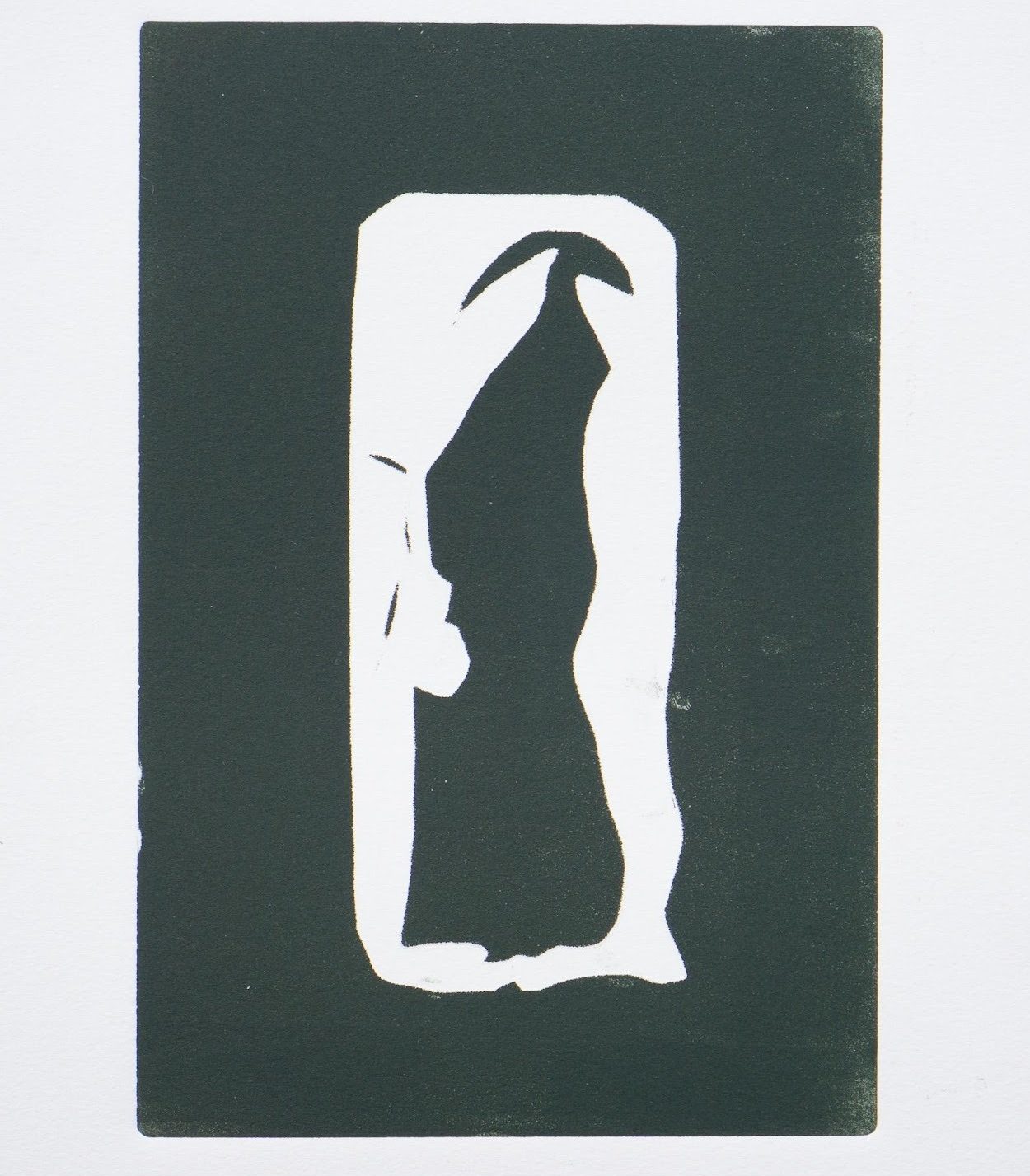
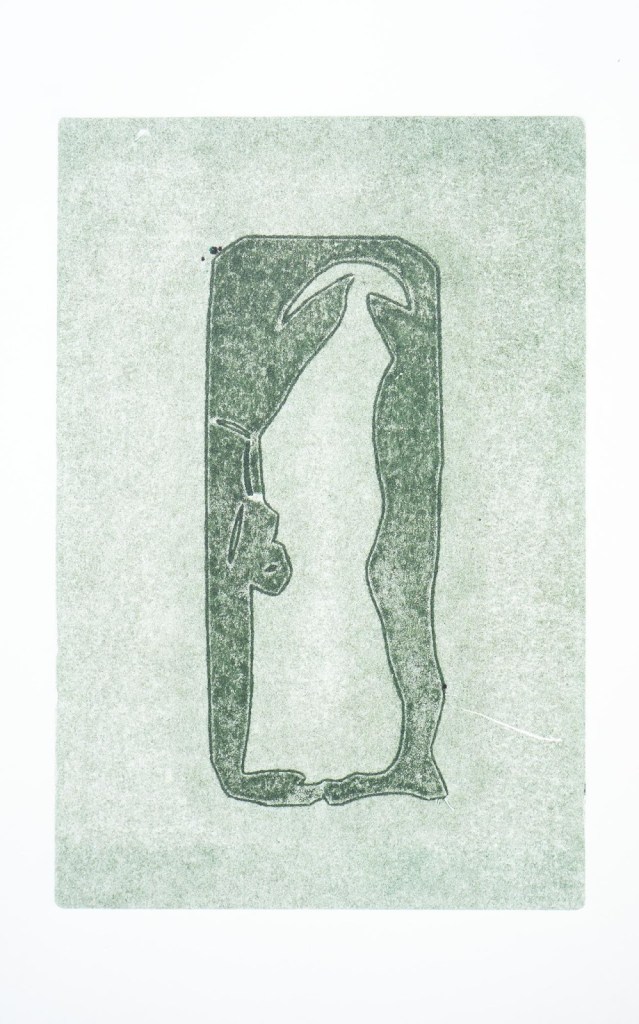
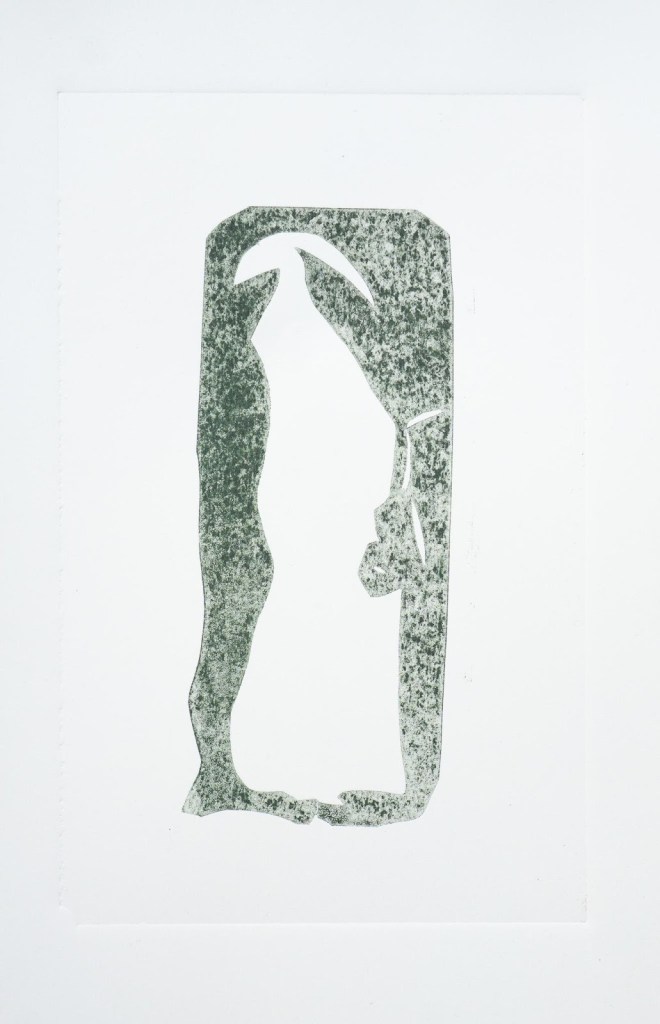
Prints are oil-based monoprints on watercolor paper, made by the author.
 jaden schapiro